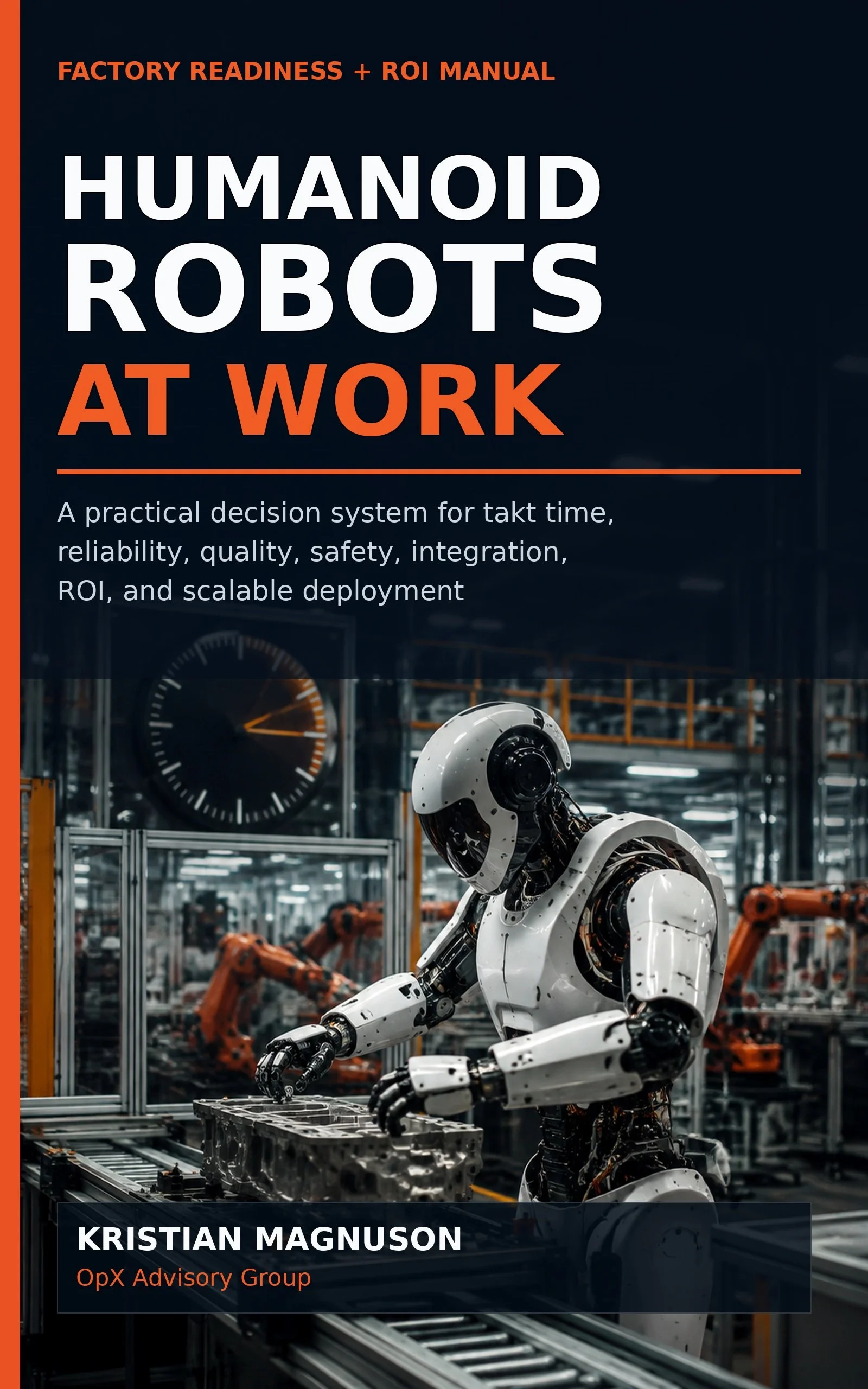
Humanoid Robots at Work: The Factory Test That Decides Whether Automation Creates Value
Executive summary
The important question is not whether a humanoid robot can complete a task in a demonstration. The question is whether it can perform the required work safely, repeatedly, at takt, at the required quality level, and at an acceptable total cost.
A production system has variation, changeovers, material shortages, abnormal conditions, maintenance interventions, human handoffs, and shifting constraints. A robot that succeeds once may still fail the operating test. Leaders therefore need a practical decision system that separates technical possibility from production readiness and finance-validated value.
The right evaluation starts with the work, not the robot. Define the task, document the current method, establish the baseline, identify the constraint, and specify the operating conditions. Then test the technology against cycle time, reliability, quality, safety, integration, and economics.
A demonstration is not a production system
Humanoid robots attract attention because they can walk, lift, manipulate objects, and adapt to environments designed for people. Those capabilities are meaningful, but a factory does not earn value from novelty. It earns value from stable flow, predictable output, safe operation, consistent quality, and disciplined capital deployment.
A polished demonstration usually removes much of the variation that exists in production. The material is positioned correctly. The path is clear. The task is repeated under controlled conditions. Real operations introduce exceptions: a part arrives out of orientation, a container is damaged, a fixture drifts, a downstream process stops, or an operator needs to enter the work area.
The operating question is therefore not, Can the robot do this? It is, Can the complete work system meet customer demand under representative conditions?
Start with takt time and the constraint
Takt time translates customer demand into the pace the process must sustain. If available production time is 420 minutes and demand is 210 units, the process needs one completed unit every two minutes.
That does not mean the robot only needs an average cycle time below two minutes. Averages can hide slow cycles, retries, resets, and recovery time. The evaluation should examine the cycle-time distribution, the slowest recurring conditions, and the effect of downtime on actual output.
The second question is whether the task is at the system constraint. Automating a non-constraint can create activity without creating throughput. It may reduce ergonomic exposure or improve consistency, which can still be valuable, but leaders should not claim a capacity or margin result unless the mechanism is clear.
Before funding a pilot, answer three questions:
- What customer or operational problem are we solving?
- Is this task at the constraint or connected to a documented cost, quality, safety, or labor problem?
- What measurable result would justify scaling?
The seven-gate factory test
1. Task and standard-work fit
Define the exact motions, decisions, materials, interfaces, exceptions, and handoffs. Stabilize the work enough to test it. Automating an unstable process usually transfers instability into software, fixtures, recovery routines, and integration work.
2. Cycle-time capability
Measure the full cycle, including part presentation, travel, grasping, placement, confirmation, and handoff. Compare median and high-percentile performance with takt. Include changeover and micro-stop effects.
3. Reliability and recovery
Track uptime, mean time between failures, restart time, manual interventions, and fault categories. A slightly slower system with predictable recovery can outperform a faster demonstration that requires frequent expert support.
4. Quality at the source
Measure first-pass yield, defect escape, rework, inspection burden, and process capability where applicable. The robot must protect critical-to-quality requirements, not simply finish the motion.
5. Safety and human interaction
Evaluate the entire application, including setup, programming, maintenance, testing, adjustment, clearing faults, and foreseeable misuse. OSHA notes that many robot incidents occur during non-routine conditions. Use the applicable risk-assessment, safeguarding, integration, and training requirements before production release.
6. Flow and integration
Test upstream material presentation, downstream acceptance, controls, data, fixtures, charging, tools, maintenance, and escalation. The robot is one component of a production system. Its value depends on the interfaces around it.
7. Economics and validation
Build the business case from a documented baseline. Include acquisition, integration, tooling, software, infrastructure, maintenance, support, training, downtime, and working-capital effects. Separate hard savings, cost avoidance, released capacity, safety value, quality value, and potential growth. Finance should validate the mechanism before the pilot is described as a return.
Run the pilot as an operating system
A useful pilot is not a technology showcase. It is a controlled operating experiment with ownership and decision rules.
Establish:
- a process owner accountable for output and adoption;
- an engineering or integration owner;
- a safety and quality review;
- a maintenance and recovery plan;
- a Finance partner for baseline and benefit validation;
- daily review of cycle time, faults, interventions, quality, and output;
- weekly review of risks, countermeasures, and scale criteria.
Run long enough to expose representative variation. Do not reset the learning every time the system encounters an exception. Capture failure modes, update standard work, improve the interface, and distinguish fixable integration problems from fundamental application mismatch.
Measures that matter
Use a compact scorecard:
- cycle time versus takt;
- uptime and productive availability;
- mean time between failure and mean time to recover;
- first-pass yield and defect escape;
- manual interventions per shift;
- safety events, near misses, and risk controls;
- throughput at the system constraint;
- labor, overtime, scrap, maintenance, and support cost;
- released capacity and its approved use;
- total cost of ownership and validated payback.
Scale only when the operating performance is repeatable, the safety case is complete, the workforce can run and recover the process, and the economic mechanism survives realistic assumptions.
The leadership decision
Humanoid robots may become a flexible automation option for tasks that are difficult to justify with dedicated equipment. But flexibility does not remove the need for Operational Excellence. It makes process definition, standard work, constraint management, maintenance, governance, and measurement even more important.
Do not buy the demonstration. Define the work, test the system, measure the constraint, and validate the value.
Continue the discussion
Watch the Humanoid Robots vs. Takt Time overview: https://www.youtube.com/watch?v=WDfrEr2Zai4
Read the Kindle edition of Humanoid Robots at Work: https://www.amazon.com/dp/B0HG63PFC3
Buy the paperback edition: https://www.amazon.com/dp/B0HG6JXDZH
Discuss a focused 90-day Business Excellence Activation and Proof-of-Value Pilot: https://www.opxadvisorygroup.com/contact
Further reading