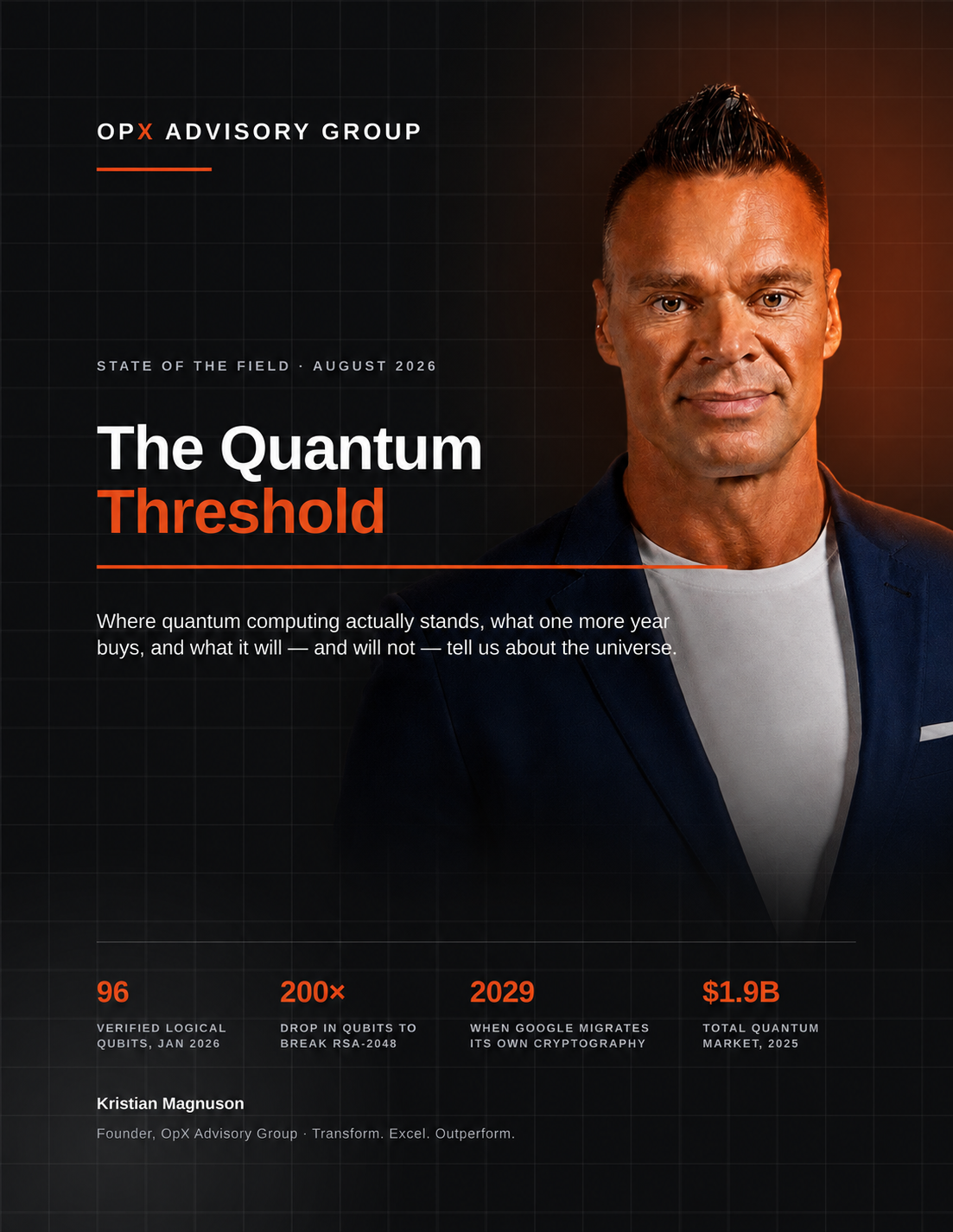
The Quantum Threshold: The Measures That Separate Progress from Hype
Executive summary
Quantum computing is often framed as a binary question: it is either already transforming business or still too distant to matter. Neither view is useful.
Progress arrives through measurable thresholds. Hardware quality improves. Error rates decline. Logical qubits become more reliable. Circuits grow deeper. Results become more repeatable. Algorithms are tested against stronger classical methods. In selected cases, technical performance may eventually cross an economic threshold that changes a real workflow.
Leaders need a disciplined way to interpret these milestones. A research demonstration can be important without being a deployable enterprise solution. A high physical-qubit count can be impressive without supporting a useful circuit. A benchmark advantage can be scientifically meaningful without producing customer or financial value.
The right question is not, “Has quantum arrived?” It is, “Which threshold has been crossed, what does it prove, and what decision should change?”
Threshold 1: Error quality
Quantum information is fragile. Noise disrupts the amplitudes, phases, and correlations that quantum algorithms rely on. This makes error rates, fidelity, coherence, calibration stability, and gate quality central measures.
Leaders should resist comparing raw qubit counts across systems without considering quality. More physical qubits do not automatically create more usable computation. The practical measure is the quality of the operations the system can perform before noise overwhelms the result.
Threshold 2: Logical qubits and error correction
A logical qubit uses error-correction methods to protect quantum information across multiple physical qubits. The transition from physical demonstrations to reliable logical computation is one of the most important thresholds in the field.
The executive questions are straightforward:
- How many logical qubits are operating?
- How much better is the logical error rate than the underlying physical error rate?
- How much physical overhead is required?
- Can the system sustain useful operations repeatedly?
Error correction is not a single finish line. It is a progression in reliability, scale, overhead, and usable computation.
Threshold 3: Circuit depth and useful work
Circuit depth describes how many sequential layers of quantum operations can be executed. Deeper circuits can support more complex algorithms, but they also accumulate more error.
A credible milestone should explain what circuit was executed, with what accuracy, at what scale, and how the result compares with a classical approach. Leaders should look beyond the headline and ask whether the experiment advances a pathway toward a practical problem.
Threshold 4: Scale and architecture
Scale includes more than qubit count. It includes connectivity, control systems, cryogenics or other infrastructure, calibration, compilation, error-correction overhead, and the ability to operate the full system consistently.
Different quantum architectures have different strengths and constraints. Raw counts across superconducting, trapped-ion, neutral-atom, photonic, and other modalities are not directly interchangeable. The relevant measure is usable capability within the architecture.
Threshold 5: Repeatability and independent verification
A result becomes more decision-relevant when it can be repeated under defined conditions and evaluated by other credible teams. Leaders should distinguish:
- a vendor roadmap from demonstrated capability;
- a press release from a technical report;
- a preprint from peer-reviewed evidence;
- a one-time experiment from repeatable performance;
- a benchmark chosen by the developer from a broadly accepted comparison.
This does not diminish early research. It clarifies what the evidence supports.
Threshold 6: Verified advantage and economics
Quantum advantage is not one universal condition. A system may outperform a classical method on a specialized benchmark without improving a business process. Enterprise value requires a stronger chain:
- The problem matters economically.
- The quantum method produces a better result, faster result, or otherwise valuable capability.
- The comparison uses a strong classical baseline.
- The result is repeatable.
- The full workflow—including data preparation, error mitigation, classical processing, access, and cost—is practical.
Only then does a technical milestone become a serious deployment or investment case.
What leaders should do now
Organizations can build readiness without betting on a speculative timeline:
Executive literacy and strategic horizon
Build enough understanding to interpret research claims, vendor roadmaps, and risk discussions accurately.
Use-case screening and economics
Focus on problems with genuine computational difficulty and measurable business value. Define the classical baseline before funding a pilot.
Data, talent, infrastructure, and partners
Strengthen mathematical modeling, optimization, simulation, data governance, and access to credible research partners.
Post-quantum cybersecurity
Inventory quantum-vulnerable cryptography, identify long-lived sensitive data, and plan migration to standardized post-quantum algorithms. This is a current governance task, not a future hardware purchase.
Controlled experiments and portfolio governance
Use evidence gates: technical feasibility, repeatability, classical comparison, economic relevance, and a clear decision after each stage.
The OpX point of view
Quantum readiness should be managed as a governed capability portfolio, not a collection of disconnected experiments. Each initiative needs an owner, business hypothesis, evidence standard, time horizon, KPI, and scale-or-stop decision.
The threshold that matters is the one that changes a business decision. Until then, the appropriate response may be education, cryptographic migration, use-case screening, partnership development, or a bounded experiment—not deployment at scale.
Watch the 60-second overview: https://youtube.com/shorts/K8V1d8Aqv-M
Read the Kindle edition: https://www.amazon.com/dp/B0HG3LFTFX
Read the paperback edition: https://www.amazon.com/dp/B0HG3LF67G
Explore OpX Quantum Computing insights: https://www.opxadvisorygroup.com/quantum-computing
Discuss a focused 90-day activation and proof-of-value pilot: https://www.opxadvisorygroup.com/contact
Further reading
- IBM Quantum Learning — Quantum computing fundamentals: https://quantum.cloud.ibm.com/learning/courses/quantum-business-foundations/quantum-computing-fundamentals
- IBM Quantum Learning — Introduction to quantum machine learning: https://quantum.cloud.ibm.com/learning/courses/quantum-machine-learning/introduction
- NIST NCCoE — Migration to post-quantum cryptography: https://www.nccoe.nist.gov/applied-cryptography/migration-to-pqc
- NIST — Post-quantum cryptography: https://www.nist.gov/pqc